
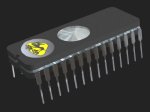
I have looked at the code from a 1499 based 'upgraded' PROM supplied by a a well known chipping company and run a compare with the stock 1499. Two bytes were changed. On analysis of the disassembly I found that one of the changed bytes breaks the call to the error subroutine made when the overboost criteria are met (and I mean breaks - the call is broken so a bunch of arbitary code gets executed instead) and the other change is to an unused byte and its purpose is simply to balance the change made to the first so that the checksum comes out unchanged and the PROM passes the power on self test.
In practice this meant that something, to the driver, much like the normal overboost fuel cut occurred on overboost but the CEL did not light nor did the code set. The cause of the abrupt power loss was in fact the 'crash' caused by the arbitray code execution I mentioned above rather than any deliberate engine protection measure.
If you look at the highway.boost.creep.ecu log at 245.8s you can see all the parameters that are put through a moving average smoothing filter get reset to zero (speed for one) and some unsmoothed variables are set to zero as well, a/f ratio & knock count included, when the corrupted overboost call is executed and this is what causes the ECU's confusion and the fuel cut.
I hope they had later versions better than this because its pathetic that this was given to someone to put in a car.
This is my opinion based on my interpretation of a code disassembly. I may have got it wrong, although the evidence in the log I mention above supports my interpretation.
| Home | WikiLEC | Repairs | Upgrades | Gallery | Buy & Sell | Mountain Chips | Meets & Events | Contact |
|
MBC vs Chip
Moderators: theelanman, dapinky, Specky, clemo, Nige, Sy V, Dave Eds, DaveT, Elanlover, muley, Enright, algirdas, nitroman, GeoffSmith
28 posts
• Page 1 of 2 • 1, 2
 by ESM » Fri 11.11.2005, 18:08
You do not have the required permissions to view the files attached to this post.
Last edited by ESM on Sat 12.11.2005, 11:04, edited 2 times in total.
It takes 43 muscles to frown and 17 to smile, but it doesn't take any to sit on your arse with a blank look on your face.
Click on my WWW link for information on chips and ElanScan.
Click on my WWW link for information on chips and ElanScan.
-
ESM - God
- Posts: 2441
- Joined: Thu 17.04.2003, 10:08
by Doc Fizzix » Fri 11.11.2005, 18:57
Is there a quick translation on this? Does this address my problem on my car?
-

Doc Fizzix - God
- Posts: 2281
- Joined: Thu 23.09.2004, 23:36
- Location: Deep in the heart of Texas
by ESM » Fri 11.11.2005, 19:06
LotusM100 wrote:Is there a quick translation on this? Does this address my problem on my car?
My comments relate to what the chip formerly in Doug's car (programmed by a well known chipping company) does. Its completely unrelated to my chips.
Last edited by ESM on Sat 12.11.2005, 10:58, edited 1 time in total.
It takes 43 muscles to frown and 17 to smile, but it doesn't take any to sit on your arse with a blank look on your face.
Click on my WWW link for information on chips and ElanScan.
Click on my WWW link for information on chips and ElanScan.
-
ESM - God
- Posts: 2441
- Joined: Thu 17.04.2003, 10:08

by Andy_R » Fri 11.11.2005, 23:55
Doug (or anyone)
After checking my service history, my CO emissions reading at MoT in June was 0.206.
I imagine that this may vary from car to car, but not having an exhaust gas analyser, what proportion ofa turn/how many turns should I give the CO potentiometre adjustment screw to increase the mixture ratio enough to up the emissions reading by about 2%?
After checking my service history, my CO emissions reading at MoT in June was 0.206.
I imagine that this may vary from car to car, but not having an exhaust gas analyser, what proportion ofa turn/how many turns should I give the CO potentiometre adjustment screw to increase the mixture ratio enough to up the emissions reading by about 2%?
-

Andy_R - Enthusiast
- Posts: 136
- Joined: Mon 10.01.2005, 13:41
- Location: Gloucester
by skywalker » Sat 12.11.2005, 00:46
Hey chaps
Monty..........Yes as a matter of fact, all 3 have had aftermarket exhausts fitted - All SJ sports cars S/S back box's.
I fitted the the first to my first 92 SE about 2 months after buying it. With no MBC, running a pure stock car other than that back box, boost increased to between 0.6-0.7 Bar - its a nice sounding back box, and really improves the flow.
As far as I'm aware, most turbo cars benifit from a "staged" exhaust system - The idea being that the front pipes are better off being stock systems to help maintain front pressure, and then a slightly bigger bore through the centre, followed by a slightly larger bore still out back to get rid of the gas quicker - This opposed to a N/A car which does not use exhaust pressure beifits from having a slightly bigger bore right through.
This is what I've been led to believe, but maybe somebody with a little more knowlage could clarify that - I know this was true to my P1 and RB5.
I then fitted a SJ sports S/S back box as soon as I'd driven my second one home. - This One had a rather dodgy Back box on it when I picked it up - looked like a Multi-fit pipe from Wilco! Hence its no longer attached!!
I'm glad to see that somebody else piped up about having no great results from the "Superchip" Chip - was begining to think it was just me. I would like to try an everest chip - it seems they have rather a close following which can only mean good things and by reading what ESM's said about the "Superchip" chip, works in a compleatley differnet manner - Just as well really!
If any of you are yet to try a S/s back box, I would highly recommend a SJ rear box - comes in at around £100 inc shipping - looks good, sounds great, and does improve performance.
Monty..........Yes as a matter of fact, all 3 have had aftermarket exhausts fitted - All SJ sports cars S/S back box's.
I fitted the the first to my first 92 SE about 2 months after buying it. With no MBC, running a pure stock car other than that back box, boost increased to between 0.6-0.7 Bar - its a nice sounding back box, and really improves the flow.
As far as I'm aware, most turbo cars benifit from a "staged" exhaust system - The idea being that the front pipes are better off being stock systems to help maintain front pressure, and then a slightly bigger bore through the centre, followed by a slightly larger bore still out back to get rid of the gas quicker - This opposed to a N/A car which does not use exhaust pressure beifits from having a slightly bigger bore right through.
This is what I've been led to believe, but maybe somebody with a little more knowlage could clarify that - I know this was true to my P1 and RB5.
I then fitted a SJ sports S/S back box as soon as I'd driven my second one home. - This One had a rather dodgy Back box on it when I picked it up - looked like a Multi-fit pipe from Wilco! Hence its no longer attached!!
I'm glad to see that somebody else piped up about having no great results from the "Superchip" Chip - was begining to think it was just me. I would like to try an everest chip - it seems they have rather a close following which can only mean good things and by reading what ESM's said about the "Superchip" chip, works in a compleatley differnet manner - Just as well really!
If any of you are yet to try a S/s back box, I would highly recommend a SJ rear box - comes in at around £100 inc shipping - looks good, sounds great, and does improve performance.
- skywalker
- Newbie
- Posts: 16
- Joined: Wed 26.10.2005, 17:35
- Location: Norwich
by Doug » Sat 12.11.2005, 01:48
ESM wrote:My comments relate to what the chip formerly in Doug's car (programmed by the company 'SuperChips') does. Its completely unrelated to my chips.
As always, what Alan wrote above is pure and true.
I just love to find the smallest flaw in his wirting so I'll point out that indeed that 'superchip' is still in my Elan, but it is piggybacked by an Everest ESM chip . . .

I told people for a few years that I'd bet the farm all that was different to the Elan chip was that CEL light; and lo and behold once Alan finally got in there an ransacked the code it is true. So all those Elans with "superchips" actually just have had 2 bits of code changed -- certainly not anything fancy like changing the spark, fuel, timing, boost tables or ANYTHING like that! You still need the MBC with a superchip, which is in fact doing 99.9% the same as in a car without the 'superboob'
Interesting that, in reality, it is the ESM chip which is truly "super"!


-

Doug - LEC Founder
- Posts: 7468
- Joined: Thu 17.04.2003, 06:43
- Location: Oregon Coast, USA
by John_W » Sat 12.11.2005, 10:12
Andy_R wrote:Doug (or anyone)
After checking my service history, my CO emissions reading at MoT in June was 0.206.
I imagine that this may vary from car to car, but not having an exhaust gas analyser, what proportion ofa turn/how many turns should I give the CO potentiometre adjustment screw to increase the mixture ratio enough to up the emissions reading by about 2%?
Andy,
There is no magic calibration between CO pot position and CO emission value. You just have to measure it. If you have a good ear for lumpy vs smooth idling, you can get pretty close. See this post:
http://www.lotuselancentral.com/forum/v ... &start=293
The CO pot will only alter the emissions at idle, so the "by ear" method is good enough for me and I've never had a problem with MOT emissions.
The CO pot is not a panacea for all emissions problems, and you should check all other engine settings are correct. See http://www.lotuselancentral.com/forum/v ... .php?t=612
Try doing a search on "CO pot" for more help.
John
-

John_W - Heid-bummer
- Posts: 3780
- Joined: Mon 21.04.2003, 12:31
- Location: Aberdeen
by ESM » Sat 12.11.2005, 10:57
Doug wrote:I just love to find the smallest flaw in his wirting so I'll point out that indeed that 'superchip' is still in my Elan, but it is piggybacked by an Everest ESM chip . . .
Yeah ok its still there but its no longer connected so bypassed would be a better way of putting it (piggybacked usually means the original device is still used but its function is modified by the piggybacked device)
Doug wrote:Interesting that, in reality, it is the ESM chip which is truly "super"!
Ah shucks

I'm twitching a bit about the potential for getting sued so I might prune some posts a bit.... Its all true but that doesn't always save you.
It takes 43 muscles to frown and 17 to smile, but it doesn't take any to sit on your arse with a blank look on your face.
Click on my WWW link for information on chips and ElanScan.
Click on my WWW link for information on chips and ElanScan.
-
ESM - God
- Posts: 2441
- Joined: Thu 17.04.2003, 10:08
by GeoffSmith » Mon 29.05.2006, 01:04
Doug wrote:I just love to find the smallest flaw in his wirting
Wirting? Is that a colonialism?
Superchip
My arse!
Calypso Red S2 #417
USB ElanScan interfaces - £60 incl. UK P&P & £65 incl. ROW P&P
USB ElanScan interfaces - £60 incl. UK P&P & £65 incl. ROW P&P
-

GeoffSmith - Kitty Fiddler
- Posts: 15628
- Joined: Fri 03.02.2006, 21:57
- Location: S2#417 in Tytherington, Gloucestershire
28 posts
• Page 1 of 2 • 1, 2
Return to Turbos, Boost, and Intakes
Who is online
Users browsing this forum: No registered users and 4 guests