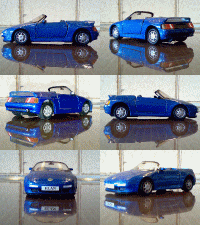
4SPD wrote:Mechanic had car for 2 weeks and came back with its overboosting......GREAT tell me something i dont know
So call Captain Enright to the rescue
Problem solved
The most bizarre problem ever !!!!!!!!!!!!!!!!!!!!!!!!!!!!!!!!!!!!!!!!!!
In my opinion anyway!
I will let Enright go into more detail but i have to say that this guy is an absolute genius. I cant believe how he not only found, but repaired the problem, in probably the best artistic repair i have ever seen
A MASSIVE THANK YOU TO HIM AND EVERYONE ELSE ON THE FORUM FOR YOUR PATIENCE AND INFORMATION ON THE POSSIBLE CAUSES
BUT MAINLY to HIM
THANK YOU
(i will leave the glory and the technical stuff for him to explain
Careful Simon, I won't be able to get my head through the door!

It turned out to be a bit of a bizarre one, and I was quite chuffed for finding and solving the problem, but many others on here could have done the same.
Here's what happened - pay attention 007, if yours ever suddenly goes wonky then this is a good one to look out for:
Firstly I found that BSV and the wastegate were properly plumbed-in, and the actuator rod moved freely.
But the timing was so far advanced that it was against the stop.
Also, the pinch bolt that secures the CAS had been half ground off because some lazy git couldn't be bothered to try to find a 6mm allen key or 12mm open-ended spanner.


There were sharp metal filings all over the place (which hurt!), hinting at some major muppetry in the timing department (not caused by Simon I hasten to add).
At least the timing mark on the crankshaft pulley had been correctly marked.
And Number 1 plug was gapped properly, even if it was very sooty.
So we hooked up my timing light, and found that even though the CAS was fully advanced, it was still firing about 5degrees AFTER TDC, with horrendous timing scatter!

I removed the CAS assembly, marked up the position of the one on my car, and tried mine on Simon's.
It was instantly spot-on.
Dodgy component located - result.
Now - could anything be done about it?
To investigate further we removed the plastic CAS cover, and made a surprising discovery:
If you held the reluctor disc steady, there was some serious play in the drive dog wheel at the opposite end of the spindle.
THAT was why the timing was all over the place.
If you ever want to change your CAS bearings, this is how to do it:
There is a little spring that secures a 4mm dia x about 20mm long peg. This peg holds the wheel with the drive dogs on it to the spindle. Once this is drifted out, the entire spindle can be pulled out.
But when I removed the spring, the peg came out in THREE pieces!!!
It had sheared in 2 places.
If we could just get a replacement peg, we could fix it.
But what could we use?

A cut-down drill - eureka!

It made a superb interference fit when cut to length and drifted in, and we used my CAS as a how-to-do-it-example.
I reassembled and refitted it, and the result was - absolutely perfect! Simon has previously done about 400 miles in a year because his Elan was such a pig to get along with.
But he was so chuffed that he resolved to treat it to new tyres, tax insurance and MOT tomorrow.
We have another resurrected Elan in our midst, and it's quite a tidy one too (or at least it WILL be)!

Elanscan is a great tool, but it's best at diagnosing electronic sensory type of problems, rather than mechanical ones.
It can frequently raise more questions than it answers, and this was a perfect example of that scenario.
You need to ask WHY it's telling you what it is, before simply trying to "shoot the messenger" and change any sensors themselves.
Of course, there's no substitute for being able to exchange possible bad components with known good ones.
It's just as useful to know what the problem ISN'T so that you can eliminate the red herrings.
And this is where the camaraderie of LEC comes into it's own.