
rip, so you have changed also - How are you getting on with it.?
Ray,
I also changed my disks in 2003, when everybody here swore that grooved and spotted disks with greenstuff pads were the only way to go - worst money I've spent - almost no change and lethal on a cold morning. I use greenstuf pads now but the rest of the brakes are a little different.
I put the lack of braking first time on a cold morning down to the IAC valve being open so low vacuum and not much servo assistance - rather than new sliders and needing to warm the pads up (tried that aswell!) If you let the engine warm up a little the brakes work!
| Home | WikiLEC | Repairs | Upgrades | Gallery | Buy & Sell | Mountain Chips | Meets & Events | Contact |
|
The cheapest way to upgrade the brakes.
Moderators: theelanman, dapinky, Specky, clemo, Nige, Sy V, Dave Eds, DaveT, Elanlover, muley, Enright, algirdas, nitroman, GeoffSmith
Re: The cheapest way to upgrade the brakes.
 by Simon_P » Tue 17.06.2014, 22:23
- Simon_P
- God
- Posts: 2602
- Joined: Fri 06.08.2004, 12:33
- Location: Kent UK
Re: The cheapest way to upgrade the brakes.
by rip » Tue 17.06.2014, 23:36
RayD wrote:You sound like Bob Iain,
The biggest problem with the stock set up has nothing to do with their capacity for dissipating heat.
If it were possible to install equipment to keep them at whatever temperature you deem suitable, you wouldn't notice any difference.
My front discs were last changed on 10th April 2003
So were Dico's discs but we all know why his have lassted so long.

I may sound like Bob. Some of what I have heard from him makes sense. Other things do not.
I completely cooked a set of new OEM discs in about 2 years to the point where they caused severe shake when braking. The pads I fitted at the same time were only about half worn.
Bob's argument about cooling wa that the intake fins are on the outside of the discs where the wheel prevents fresh air from entering. This is particularly true of the Fed alloys, which my Elan has. These are almost like plates over the discs allowing very little fresh air to circulate. By comparison, the SE 15" wheels & S2s are a lot more open.
Simon: I have Vectra calipers with Subaru discs on the front (which won't fit under 15" wheels
 ) & PNMs on the rear. The brake pedal is very easy to operate now. I also have PNM calipers on the rear. I fitted these because my handbrake has always been terrible, with OEM & Dorman calipers. I finally have brakes which I feel suit the car. Expensive? Maybe. Improvement? Certainly. Worthwhile? Up to the individual.
1990 SE
-

rip - God
- Posts: 5905
- Joined: Sun 08.04.2007, 07:48
- Location: Milton Keynes, UK
Re: The cheapest way to upgrade the brakes.
by RayD » Wed 18.06.2014, 10:59
rip wrote:RayD wrote:My front discs were last changed on 10th April 2003
So were Dico's discs but we all know why his have lasted so long.
I know you’re only kidding Iain but my car’s done 18,000 miles since the discs were fitted. (32482 to 50004) It’s never been “off the road”
rip wrote:I may sound like Bob. Some of what I have heard from him makes sense. Other things do not.
I think when you’re relying on someone to the extent people relied on Bob they ought to always make sense.
rip wrote:Bob's argument about cooling wa that the intake fins are on the outside of the discs where the wheel prevents fresh air from entering. This is particularly true of the Fed alloys, which my Elan has. These are almost like plates over the discs allowing very little fresh air to circulate. By comparison, the SE 15" wheels & S2s are a lot more open.
Bob’s a bit like me in this respect in that he has no idea how the air flow compares one to the other.
There’s never been a pattern of Federal cars failing over S2’s in that regard.
If I remember rightly I suggested to Bob to consider the wheel under water ... the pumping action would almost certainly be identical, regardless of the type of wheel or the orientation of the disc.
I don’t profess to know everything Iain; I’m just as likely to be asking questions as answering them. There’s a lot of people on here who know more about cars than me, and there’ll be some who know more about engineering, but Bob Brown isn’t one of them.
If he wants to argue the toss he needs to get back on here and speak for himself.
Ray
-
RayD - Forum Member
- Posts: 2142
- Joined: Mon 20.03.2006, 19:45
- Location: South Yorkshire
Re: The cheapest way to upgrade the brakes.
by tweetdriver63 » Wed 18.06.2014, 11:04
Bob did put together a nice little kit to adapt the Subaru discs and the Saab/Vectra calipers for the front. That's the only thing I did to mine (aside from waste some money on slotted discs and better pads before that), and it's made a world of difference.
Also, if we get back to the original question, which was about the cheapest way to upgrade the brakes, I'd say (and I think everybody else who's done it would agree) that the answer to that is the Subaru discs and Saab/Vectra calipers.
Also, if we get back to the original question, which was about the cheapest way to upgrade the brakes, I'd say (and I think everybody else who's done it would agree) that the answer to that is the Subaru discs and Saab/Vectra calipers.
Chris
______________________________________
'91 Elan SE
'04 MB C230 Sport Coupe
'08 Mercury Mariner Hybrid
'12 Evora S GP Edition (In my dreams - HA!)
______________________________________
'91 Elan SE
'04 MB C230 Sport Coupe
'08 Mercury Mariner Hybrid
'12 Evora S GP Edition (In my dreams - HA!)
-

tweetdriver63 - God
- Posts: 2688
- Joined: Tue 07.08.2007, 17:12
- Location: Mississippi,USA
Re: The cheapest way to upgrade the brakes.
by inkitin » Wed 18.06.2014, 11:08
RayD wrote:If he wants to argue the toss he needs to get back on here and speak for himself.
I wholeheartedly agree Ray but I think the engineering side of brakes may occupy the very least of Bob's time!!

91 SE Calypso Red
inkitin: 28/09/1949 - 23/07/2014
inkitin: 28/09/1949 - 23/07/2014
-

inkitin - Sadly departed but never forgotten
- Posts: 1549
- Joined: Sat 27.10.2007, 14:02
- Location: Manchester
Re: The cheapest way to upgrade the brakes.
by rip » Wed 18.06.2014, 11:33
tweetdriver63 wrote:Bob did put together a nice little kit to adapt the Subaru discs and the Saab/Vectra calipers for the front. That's the only thing I did to mine (aside from waste some money on slotted discs and better pads before that), and it's made a world of difference.
Also, if we get back to the original question, which was about the cheapest way to upgrade the brakes, I'd say (and I think everybody else who's done it would agree) that the answer to that is the Subaru discs and Saab/Vectra calipers.
I agree that this is a relatively inexpensive upgrade & a massive improvement but it will have changed the brake bias towards the front.
Bringing the bias back again requires more spending.
The modification mentioned in this thread does not adjust the bias at all so could be considered a complete solution.
Here's another thing to consider:
If you increase front brake performance, then you will be able to stop more quickly & would probably stop more quickly more regualrly. When you are stopping more sharply, your dynamic mass will be further forwards so surely you would want the brake bias to be shifted a little forwards anyway?
BTW, I cooked a set of Cavalier brakes in the past too. I imagine it could be the huge succession of roundabouts in Milton Keynes...lots 70-20 brakings without giving the brakes a lot of time to cool in between. Maybe this could be a factor as to why I warped a set of OEM Elan discs so quickly?
1990 SE
-
rip - God
- Posts: 5905
- Joined: Sun 08.04.2007, 07:48
- Location: Milton Keynes, UK
Re: The cheapest way to upgrade the brakes.
by Enright » Wed 18.06.2014, 12:00
Iain, I totally agree with your first paragraph, and will be seriously keeping an eye out for any of these master cylinders.
I'm not sure about the second bit though - if we assume that Lotus got the bias on the safe side of right (i.e. a bit forwards anyway), then surely we don't want to shift bias forwards any more or the rear brakes will be even less effective.
Some time back ESM made a fantastic post about how fitting bigger brakes at the front actually INCREASES stopping distances, because the fronts lock before the rears are braking efficiently. (Edit: actually it's AGES ago - see here: viewtopic.php?f=41&t=3270&hilit=bias , and it prompted a very educational discussion)
PS I know what you mean about MK too - it's pretty hard on fuel economy in that neck of the woods!
Striking fear into the hearts of duplicate posts everywhere...! 
BCingU,
Neil
BCingU,
Neil
-
Enright - Modificator
- Posts: 4860
- Joined: Sun 19.12.2004, 19:21
- Location: Arnold, Nottingham, England
Re: The cheapest way to upgrade the brakes.
by dapinky » Wed 18.06.2014, 12:28
I've made a (lengthy) post somewhere on the forum in the past about my considerations (and they're only that - should not be taken as gospel) about a possible way to address the brake bias situation fairly cheaply.....
.... basically, it is just a case of changing the 2/15 proportioning valves to 3/15 versions (or if you already have 3/15 valves, removing the limiting valves from the system).
This is on my list of things to do, and will be looked into again when time/health/other jobs permit.
Edit - here is the thread
Dave
Just the one now, but this one's mine! - and it will be finished eventually..... - but also temporary custodian of a project until it is finished enough for Angie to drive it
...oh, and a 2006 Freelander destined for the jungles of The Gambia - 4500 miles across roads, desert and tracks - what could possibly go wrong?
-

dapinky - LEC Administrator
- Posts: 10625
- Joined: Sun 15.10.2006, 12:54
- Location: As far west as you can get in West Wales before you become Irish (Pembroke Dock).
Re: The cheapest way to upgrade the brakes.
by rip » Wed 18.06.2014, 13:30
That's an interesting thread you've referred to there, Neil. Much better to look through a previous discussion than to repeat it. Anyone would think you don't like duplicate postings .
Interesting to see Dave's comment about 3/15 valves too. That's the first time I remember seeing it mentioned. Previously many have fitted bigger front brakes, let the existing valves take most of the rear effort away then try to recover what is left by fitting bigger rears too. Getting the rears to do more seems a lot more sensible. If they are moving more then will this also make them seize less readily?
.Interesting to see Dave's comment about 3/15 valves too. That's the first time I remember seeing it mentioned. Previously many have fitted bigger front brakes, let the existing valves take most of the rear effort away then try to recover what is left by fitting bigger rears too. Getting the rears to do more seems a lot more sensible. If they are moving more then will this also make them seize less readily?
1990 SE
-
rip - God
- Posts: 5905
- Joined: Sun 08.04.2007, 07:48
- Location: Milton Keynes, UK
Re: The cheapest way to upgrade the brakes.
by Enright » Wed 18.06.2014, 15:51
Oh, it's such a enlightening discussion that I couldn't hope to offer any more to it than the veritable guru/s that started it in the first place.
And I wouldn't presume to plagiarise it either.
I thought that the content was quite incredible, because it flew in the face of so much that seemed to be the accepted norm.
It's funny how since then, on websites for other car marques, I've ended up arguing with idiots that were convinced that bigger brakes magically made their tyres stickier!!!
As for your comment about giving them more exercise making them seize less Iain - I'd have to agree. After all, the biggest problems that people seem to have experienced with the brakes (myself included) has been getting them through MoT tests after long periods of lack of use.
Unfortunately you can get caught between the devil and the deep on that one: you can't get on the road and start getting regular use out of the car without an MoT, but you can't get the car MoT'd without the brakes being nice and free - which means being subjected to regular use - doh!
Striking fear into the hearts of duplicate posts everywhere...!
BCingU,
Neil
BCingU,
Neil
-
Enright - Modificator
- Posts: 4860
- Joined: Sun 19.12.2004, 19:21
- Location: Arnold, Nottingham, England
Re: The cheapest way to upgrade the brakes.
by tweetdriver63 » Wed 18.06.2014, 18:14
rip wrote:tweetdriver63 wrote:Bob did put together a nice little kit to adapt the Subaru discs and the Saab/Vectra calipers for the front. That's the only thing I did to mine (aside from waste some money on slotted discs and better pads before that), and it's made a world of difference.
Also, if we get back to the original question, which was about the cheapest way to upgrade the brakes, I'd say (and I think everybody else who's done it would agree) that the answer to that is the Subaru discs and Saab/Vectra calipers.
I agree that this is a relatively inexpensive upgrade & a massive improvement but it will have changed the brake bias towards the front.
Bringing the bias back again requires more spending.
The modification mentioned in this thread does not adjust the bias at all so could be considered a complete solution.
Here's another thing to consider:
If you increase front brake performance, then you will be able to stop more quickly & would probably stop more quickly more regualrly. When you are stopping more sharply, your dynamic mass will be further forwards so surely you would want the brake bias to be shifted a little forwards anyway?
BTW, I cooked a set of Cavalier brakes in the past too. I imagine it could be the huge succession of roundabouts in Milton Keynes...lots 70-20 brakings without giving the brakes a lot of time to cool in between. Maybe this could be a factor as to why I warped a set of OEM Elan discs so quickly?
It may move the bias a little toward the front, but the only thing I've ever noticed is that it moves the bias toward stopping, instead of having to go off the road to avoid the rear end of the guy ahead of me.

Chris
______________________________________
'91 Elan SE
'04 MB C230 Sport Coupe
'08 Mercury Mariner Hybrid
'12 Evora S GP Edition (In my dreams - HA!)
______________________________________
'91 Elan SE
'04 MB C230 Sport Coupe
'08 Mercury Mariner Hybrid
'12 Evora S GP Edition (In my dreams - HA!)
-
tweetdriver63 - God
- Posts: 2688
- Joined: Tue 07.08.2007, 17:12
- Location: Mississippi,USA
Re: The cheapest way to upgrade the brakes.
by Brit-Car-Nut » Wed 18.06.2014, 19:35
To try and provide some insight into the Bigger Calipers vs Smaller Master Cyl Bores, I dug out this discussion:
Methods for Improving Braking Performance:
Pedal Ratio
The critical component in the braking equation is the pedal ratio. In operation, the brake pedal acts as a lever to increase the force the driver applies to the master cylinder. In turn, the master cylinder forces fluid to the disc brake caliper pistons or drum brake wheel cylinders. If you examine a brake pedal, you'll see the pivot point (where the pedal swivels) and the mounting point for the master cylinder pushrod are usually different. By varying the length of the pedal, and/or the distance between the pushrod mount and the pivot, you can change how much force (from your leg) is required to energize the master cylinder. This is the "mechanical advantage" or pedal ratio. This formula will help you figure it out: Input Force x Pedal Ratio ÷ Brake Piston Area = PSI.
Mathematical babble? The arithmetic simply equates to the amount of force exerted by your leg times the pedal ratio divided by the area of the brake piston(s). FYI, the typical adult male can exert roughly 300 pounds of force (maximum) with one leg-and that's a bunch. Something in the order of 1/3 or 1/2 that figure is obviously more comfortable, even in a hardcore racecar.
The average manual (non-power boosted) master cylinder requires somewhere between 600-1,000 PSI to be totally effective. Somehow, 100-150 pounds of leg force has to be translated into 600-1,200 PSI. The way it's accomplished is by way of pedal ratio. While changing the overall length of the pedal is possible, it's often easier and far more practical to shorten the distance between the pivot point and the master cylinder pushrod mount location. That's precisely how many racecar chassis shops modify brake pedals.
Brake Line Pressure
Brake line pressure is a different thing than the force you apply to the pedal. Force acts in one direction and is addressed in pounds. Pressure acts in all directions against surrounding surfaces and is addressed in pounds per square inch or PSI. "Levers" (brake pedals) can be used to change the force. Inside the hydraulic system, the surface area of the piston is what is affected by pressure. Decreasing the bore size of the master cylinder increases the pressure it can build. Pistons in master cylinders are specified by bore size. But there's a hitch: The area of a circle (or bore) is Pi-R-Squared. The area of the piston surface increases or decreases as the square of the bore size or diameter. For example, the area of a common 1-1/8-inch master cylinder is approximately 0.994-inch. The area of an equally common 1.00-inch bore master cylinder is approximately 0.785-inch. Switching from the larger master cylinder to the smaller version will increase the line pressure approximately 26.5% assuming that pedal ratio hasn't changed
As the pedal force or the pedal ratio (or both) is increased, the stroke of the master cylinder is shortened (brake line pressure is unaffected). When the size of the master cylinder piston increases, the output pressure of the master cylinder decreases. A smaller master cylinder piston will exert more line pressure with the same amount of force (pedal ratio) than a master cylinder piston with a larger piston area. There's another catch: Since the brake line fluid pressure is working against the surface of the wheel cylinder (or disc brake piston), increasing the area of the cylinder will increase brake torque.
Improved Braking
The bottom line is, if the stopping power of a car needs improvement, or if there's a need to reduce the pedal effort, several options are available: (1) Decrease the master cylinder bore size; (2) Increase the pedal ratio; (3) Increase the wheel cylinder bore size. If the pedal ratio is increased, there will be more travel at the master cylinder piston. If the master cylinder bore size is decreased, the piston has to travel further to move the same amount of fluid. Typically, a master cylinder has approximately 1-1/2-inch to 1-3/4-inch of stroke (travel). The idea here is coordinate the pedal ratio with the bore size to arrive at approximately half of the stroke (roughly 1-inch) in order to make the brakes feel comfortable, and of course, to bring the car to a grinding halt.
Mark Williams Enterprises, 765 South Pierce Avenue, Louisville, CO 80027
We can't do much with Pedal Ratio so the easiest solution is to go to larger Caliper Pistons or smaller BMC pistons. Going to a LARGER DISC and moving the Caliper outboard also works but only if you can still get the brakes inside the wheel's rim.
Bigger components will also reduce air flow as they take up more of the limited space inside the wheel cavity.
Please contact me via eMail, not by PM
- Brit-Car-Nut
- God
- Posts: 4820
- Joined: Tue 03.07.2007, 17:07
- Location: Charlotte, NC USA
Re: The cheapest way to upgrade the brakes.
by Brit-Car-Nut » Wed 18.06.2014, 19:41
We know the Brake Master Cylinder came from the Pontiac Lemans.
The 1.6L used a 13/16" (20.64mm) BMC Bore while the 2L versions used a 7/8" (22.22mm) BMC Bore
The 1.6L versions used 48mm caliper pistons while the 2L used 54mm caliper pistons
The Front Calipers came from the Pontiac Grand AM
The SOLID Disc version used 2.25" (57.15mm) pistons
The VENTED Disc version used 57mm
BOTH of these cars had DRUM rear brakes but they had tandem BMCs so the info should still be useful.
So, using the Pontiac Lemans 1.6L engine model's 20.64mm BMC and the GrandAM Vented Disc Calipers should improve the brake performance.
The huge problem is the US, Pontiac models used a rear brake pressure valve mounted at the BMC so the female thread for the rear brake lines is WRONG.
The BMC suggested by johanvanboven has a 20.6mm bore and it HAS the correct threaded fittings..
Is there a listing of the actual bores of the calipers and BMC used on the M100?
That might help with the determination of what "off the shelf" parts might improve braking.
I know that when I sourced a M13001 (10.6mm) BMC, I was told it was the wrong bore for the STOCK M100.
That is all I have been able to document over the years except that I feel that johanvanboven really hit the nail on the head when he found the part number and dimensions of the Opel BMC.
Last edited by Brit-Car-Nut on Tue 08.07.2014, 21:48, edited 1 time in total.
Please contact me via eMail, not by PM
- Brit-Car-Nut
- God
- Posts: 4820
- Joined: Tue 03.07.2007, 17:07
- Location: Charlotte, NC USA
Re: The cheapest way to upgrade the brakes.
by Simon_P » Tue 08.07.2014, 20:35
johanvanboven wrote:Some part ref. for TRW172:
Opel 558034 or 558040: no longer supplied.
Vauxhall 3488959
ATE 24.2120-1711.3 or 27.2100-0726.3
Bendix 132111B or 3613030
Bosch 0986480095
Delphi LM50014
Lucas 2676966085 , 32967226 , 32967365
Unipart GMC826
Goodluck finding it.
I managed to find a cross reference to the LM50014 - FirstLine.... They were the right price so I bought all 3
I have 2 up for grabs at £25 each +P&P - PM if you are interested.
See for sale section
viewtopic.php?f=131&t=23482#p295660
- Simon_P
- God
- Posts: 2602
- Joined: Fri 06.08.2004, 12:33
- Location: Kent UK
Re: The cheapest way to upgrade the brakes.
by Simon_P » Sun 05.10.2014, 21:10
Fitted!
Much much better - should have done this 6 years ago when Ray suggested it
Thanks Johan for providing the motivation.
I still need to do some bleeding, but I can lock up the front left every time I try!
Much much better - should have done this 6 years ago when Ray suggested it
Thanks Johan for providing the motivation.
I still need to do some bleeding, but I can lock up the front left every time I try!
- Simon_P
- God
- Posts: 2602
- Joined: Fri 06.08.2004, 12:33
- Location: Kent UK
Re: The cheapest way to upgrade the brakes.
by lotusflasherman » Fri 14.11.2014, 03:02
I've just read this thread for the first time and am horrified about what you guys are saying and doing.... I built racing saloons in the early 70's and fitted tandem master cylinders to comply with RAC Competition Regulations about dual circuits so have some understanding of how they work, particularly after abortive attempts to adjust brake bias using them! - What you call climbing the learning curve!
There seems to be a general ignorance about how these work so I'd better deal with that first.... sorry Dave but I disagree with your post of 16/12/13. They are dual circuit, meaning 2 independent circuits, when the car comes out of the factory anyway, and worked as such when I hit a number plate that had fallen off a lorry and it severed my Elan's n/s front brake pipe as I approached a roundabout but I braked OK (just) on the remaining circuit o/s front, n/s rear and drove carefully for 30 miles to Pat Thomas near Spalding for him to fit a set of Goodridge hoses. I concluded 4 brakes better than 2, but 2 infinitely better than NONE.
There are 2 circuits fed from a common reservoir with a weir to preserve some fluid for the healthy circuit in the event of the failure of the other. When either circuit fails the appropriate piston will move freely to hit a mechanical stop and the appropriate seal provides a hydraulic lock for the healthy circuit to maintain pressure. That free movement does take up quite a lot of pedal travel though, which is why I'm writing this.
It's explained quite well here: http://www.britishv8.org/articles/tandem-master-cylinders.htm but they do talk about front and rear circuits where as most cars are split diagonally nsf/osr, osf/nsr.
I've copied their pictures below but explanation here is mine ... ignore the "Rear Wheel Drive Application" , "To Front Brakes" & "To Rear Brakes" text on the drawings.
Failure of 'green circuit' fed by Piston1 means rod from pedal pushes Piston 1 mechanically against Piston 2 and it still creates pressure in the 'pink circuit' No 2.
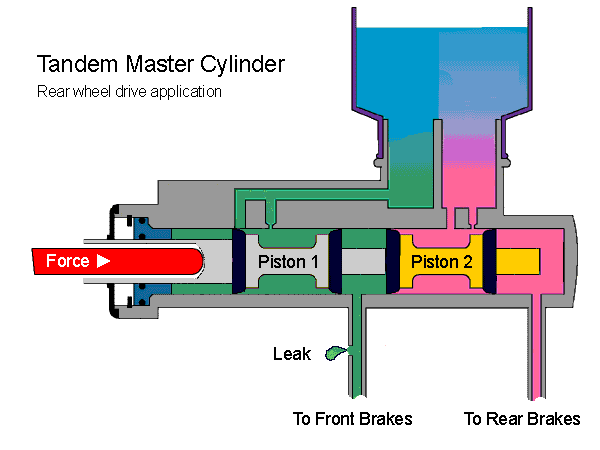
Failure of 'pink circuit' fed by Piston 2 means pressure from Piston 1 will cause Piston 2 to hit the mechanical end stop at the end of the cylinder and Piston 1 can then create pressure in the 'green circuit' No 1.
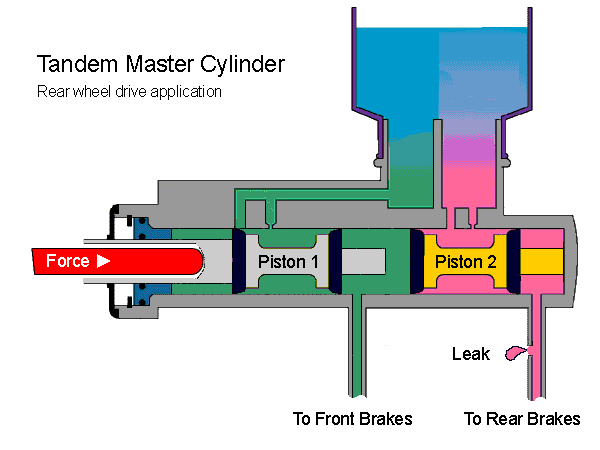
so all good news for those using Lotus original master cylinders but be warned that when one circuit fails there is an awful lot of pedal travel before it goes solid and you find (eventually) that you still have one circuit working. Next time you are bleeding the brakes with just one bleed valve open press hard on the brake pedal and you'll find where the pedal is when the other circuit is under pressure - check the other wheels don't turn if you want to satisfy yourselves that you have dual independent circuits and the other is still working.
I think that all those who have fitted this so called improvement that creates longer pedal travel had better, as a matter of urgency, check that with one bleed valve open they can still create pressure in the other circuit before the pedal hits the carpet under all conditions - make sure handbrake is off too. If not put the original master cylinder back on before a single circuit brake failure sees you wiping out a bunch of school kids waiting for a bus because you haven't understood the implications of swapping master cylinders.
and by the way - I can lock my brakes with the standard set up if I'm stupid enough to stand on the pedal that hard but I used to race Mini's with big fat slicks and no servo so perhaps I grew up used to a hard pedal. The fun bit is to get the tyres smoking without locking up and creating flat spots, then you know you've got your braking just right...
Phil Johnstone
There seems to be a general ignorance about how these work so I'd better deal with that first.... sorry Dave but I disagree with your post of 16/12/13. They are dual circuit, meaning 2 independent circuits, when the car comes out of the factory anyway, and worked as such when I hit a number plate that had fallen off a lorry and it severed my Elan's n/s front brake pipe as I approached a roundabout but I braked OK (just) on the remaining circuit o/s front, n/s rear and drove carefully for 30 miles to Pat Thomas near Spalding for him to fit a set of Goodridge hoses. I concluded 4 brakes better than 2, but 2 infinitely better than NONE.
There are 2 circuits fed from a common reservoir with a weir to preserve some fluid for the healthy circuit in the event of the failure of the other. When either circuit fails the appropriate piston will move freely to hit a mechanical stop and the appropriate seal provides a hydraulic lock for the healthy circuit to maintain pressure. That free movement does take up quite a lot of pedal travel though, which is why I'm writing this.
It's explained quite well here: http://www.britishv8.org/articles/tandem-master-cylinders.htm but they do talk about front and rear circuits where as most cars are split diagonally nsf/osr, osf/nsr.
I've copied their pictures below but explanation here is mine ... ignore the "Rear Wheel Drive Application" , "To Front Brakes" & "To Rear Brakes" text on the drawings.
Failure of 'green circuit' fed by Piston1 means rod from pedal pushes Piston 1 mechanically against Piston 2 and it still creates pressure in the 'pink circuit' No 2.
Failure of 'pink circuit' fed by Piston 2 means pressure from Piston 1 will cause Piston 2 to hit the mechanical end stop at the end of the cylinder and Piston 1 can then create pressure in the 'green circuit' No 1.
so all good news for those using Lotus original master cylinders but be warned that when one circuit fails there is an awful lot of pedal travel before it goes solid and you find (eventually) that you still have one circuit working. Next time you are bleeding the brakes with just one bleed valve open press hard on the brake pedal and you'll find where the pedal is when the other circuit is under pressure - check the other wheels don't turn if you want to satisfy yourselves that you have dual independent circuits and the other is still working.
I think that all those who have fitted this so called improvement that creates longer pedal travel had better, as a matter of urgency, check that with one bleed valve open they can still create pressure in the other circuit before the pedal hits the carpet under all conditions - make sure handbrake is off too. If not put the original master cylinder back on before a single circuit brake failure sees you wiping out a bunch of school kids waiting for a bus because you haven't understood the implications of swapping master cylinders.
and by the way - I can lock my brakes with the standard set up if I'm stupid enough to stand on the pedal that hard but I used to race Mini's with big fat slicks and no servo so perhaps I grew up used to a hard pedal. The fun bit is to get the tyres smoking without locking up and creating flat spots, then you know you've got your braking just right...
Phil Johnstone
Phil
Leave me alone, I think I know what I'm doing.
Cars: Subaru Forester 2.5XTN, Eclat Riviera, brace of Pacific Blue SE's, Collapso SE, Elan+2S.... and now an Evora
Leave me alone, I think I know what I'm doing.
Cars: Subaru Forester 2.5XTN, Eclat Riviera, brace of Pacific Blue SE's, Collapso SE, Elan+2S.... and now an Evora
-
lotusflasherman - God
- Posts: 2533
- Joined: Fri 05.09.2008, 00:14
- Location: Hadleigh, 15m west of Ipswich or I may be 800 miles south (Cap d'Agde)
Re: The cheapest way to upgrade the brakes.
by dapinky » Fri 14.11.2014, 12:59
Phil,
I'm quite happy for you to disagree with what I wrote (as at least you have an understanding of the subject!).
Having re-read it, I think it's still correct, but maybe not worded too well.
The very best understanding of the brake master cylinder workings is on youtube(at least, it appears to explain it quite well).
I maintain that there isn't always enough pressure in one side of the system to work enough brakes to stop the car in all circumstances, even with the OE master cylinder....
...maybe it's down to my driving, but I hate ABS in any car, and prefer (and have always taught) cadence braking, so 'pumping' the pedal to increase pressure is a natural process for me, I suppose.
Somewhere in the thread (or it might be on another one), I published all the maths involved in the fluid displacement for OE callipers, Hi-Specs, Willwoods etc, and concluded that the swap in cylinders would still allow enough fluid transfer with the system I have on the car (OE callipers) with enough of a safety margin to allow for a system failure downstream of the M/C, but it may not be enough for a 'brake caliper upgrade' which transfers more fluid.
Since fitting the cylinder, I have noticed a longer travel, but I also tested it on the brake rollers at the MOT station with a simulated fluid leak (slow leak AND sudden major leak).
As I expected, there is still enough pressure to do something, but not enough to stop the car (same as the OE cylinder) - but by cadence braking, it increased to a level where the wheels will slow down much better...... Who knows if that will be enough in a 'real world' situation????
One thing we agree on, is that a lot of people may well be messing with things that they don't understand, and have no reliable means of evaluating/testing.
What I now find worthy of further exploration is where i induced my 'leaks' when i did my tests - I feel that I may need to do it for both Primary and Secondary systems (and maybe re-consider the plumbing!).
(PS - there IS sufficient movement of the brake pedal to lock it all up with this set-up)
PPS - maybe a much easier way to achieve the same results is to look more at the physical leverage/pivots of the brake pedal - it is an ongoing process
Dave
Just the one now, but this one's mine! - and it will be finished eventually..... - but also temporary custodian of a project until it is finished enough for Angie to drive it
...oh, and a 2006 Freelander destined for the jungles of The Gambia - 4500 miles across roads, desert and tracks - what could possibly go wrong?
Just the one now, but this one's mine! - and it will be finished eventually..... - but also temporary custodian of a project until it is finished enough for Angie to drive it
...oh, and a 2006 Freelander destined for the jungles of The Gambia - 4500 miles across roads, desert and tracks - what could possibly go wrong?
-
dapinky - LEC Administrator
- Posts: 10625
- Joined: Sun 15.10.2006, 12:54
- Location: As far west as you can get in West Wales before you become Irish (Pembroke Dock).
Re: The cheapest way to upgrade the brakes.
by lotusflasherman » Fri 14.11.2014, 16:50
Dave,
YouTube video is fairly good explanation, not quite same plumbing as on Elan but principles still apply. It mentions that modern cars should have two systems so one works when other fails and I think that is why Lotus made decisions about pedal travel, pivot points, mechanical advantage, bore size etc etc. When I lost one circuit the other worked fine but the mechanical displacement of the piston on the failed circuit takes up a lot of pedal travel so it's almost in the carpet when it works - bit heart-stopping until you get to it! Cadence braking pumps up fluid but I don't see how it can overcome 'mechanical slack' in the system.
On the thread I saw somebody claim that he had no brakes when one circuit failed and I don't dispute that but am wondering if all pads are worn so pistons are a long way out of the calipers whether the volume of fluid in the circuit is so great that you run out of pedal travel before creating a usable pressure - just a thought. I'll let somebody else do the maths... but it's all theory and what actually happens is more important.
The acid test is to open a bleed nipple to simulate a failure and check you can still lock up the brakes on the other circuit, if you can great... if not there's a problem to be solved, and I'd check all 4 as pad thickness and proportioning valves in rear circuits all add variables.
I generally keep 'plenty of meat' on my pads so the pad acts as the heat-sink, rather than thin pads passing it to the back plate and through the piston to the caliper body and fluid. Set of good pads doesn't cost more than a tank of fuel and never had any problem with overheating brakes that some people refer to - but I don't use my brakes for long - in deep, one hard stab and round we go ... that's what Elans were designed for.
Phil
Phil
Leave me alone, I think I know what I'm doing.
Cars: Subaru Forester 2.5XTN, Eclat Riviera, brace of Pacific Blue SE's, Collapso SE, Elan+2S.... and now an Evora
Leave me alone, I think I know what I'm doing.
Cars: Subaru Forester 2.5XTN, Eclat Riviera, brace of Pacific Blue SE's, Collapso SE, Elan+2S.... and now an Evora
-
lotusflasherman - God
- Posts: 2533
- Joined: Fri 05.09.2008, 00:14
- Location: Hadleigh, 15m west of Ipswich or I may be 800 miles south (Cap d'Agde)
Re: The cheapest way to upgrade the brakes.
by dapinky » Fri 14.11.2014, 18:12
Phil,
I totally agree that everything should be as well maintained as possible, so there is less 'mechanical slack' to take up on any occassion - I can only speak for myself that in my car there is sufficient pedal travel to get something to work before it runs out of movement (with an induced leak).
Theoretically, if there is sufficient total volume of fluid to do it with the OE master cylinder, then reducing the bore will have only a minimal influence on the total pedal travel in the event of a failure - the length of the cylinder remains the same, so the point at which the 'good' half works should be at the same point in the piston travel (once the compensator valve is overcome and the rod hits the other piston (or end wall if it's that side which has failed) - obviously, to get to that point, less fluid will have been displaced (due to the narrower bore), so there will be more 'slack' to have to take up.
My calculations were based on an estimated caliper piston movement of 1mm on each of the 4 corners, but in a well-maintained and 'freely sliding' system, it is probably nearer to 0.5mm - even if you allow 2mm of travel there is sufficient volume of fluid movement before the M/C piston comes to a stop...
...the one thing I didn't take account for is thickness of carpet/underfelt and any extra mats which may interfere with the full pedal travel on other peoples' cars - but that is something which isn't allowed for in the original item either.....
... and probably the main thing which should worry people in the event of a failure is air in the system - gas will compress wheras fluid wont, so any bubbles will only make things worse - maybe not noticable under normal use, but could make a difference in an emergency.
As always, I don't ever advocate messing with things which aren't well-enough understood, and whilst the system works for me, it may not be as simple as made out, depending on any other variables in the individual car.
I'm happy that my maths are correct, the measurements were taken before I made any 'swaps' and again afterwards - and it's a real bugger to measure the throw of the actuating piston for the master cylinder before the pedal hits the floor - you can either see it, feel it, or move the pedal - but getting it all done at the same time whilst holding callipers in your third hand isn't easy - in the end i just removed the master cylinder and measured it from the engine bay with my son operating the pedal.
Dave
Just the one now, but this one's mine! - and it will be finished eventually..... - but also temporary custodian of a project until it is finished enough for Angie to drive it
...oh, and a 2006 Freelander destined for the jungles of The Gambia - 4500 miles across roads, desert and tracks - what could possibly go wrong?
Just the one now, but this one's mine! - and it will be finished eventually..... - but also temporary custodian of a project until it is finished enough for Angie to drive it
...oh, and a 2006 Freelander destined for the jungles of The Gambia - 4500 miles across roads, desert and tracks - what could possibly go wrong?
-
dapinky - LEC Administrator
- Posts: 10625
- Joined: Sun 15.10.2006, 12:54
- Location: As far west as you can get in West Wales before you become Irish (Pembroke Dock).
Re: The cheapest way to upgrade the brakes.
by lotusflasherman » Fri 14.11.2014, 19:53
Dave,
'mechanical slack' - you just reminded me that on my first Elan, that got to 150,000 miles, I had an annoyingly 'creaky' sound from the brake pedal. I found it was coming from the clevis pin passing through the brake pedal, which was totally dry and the pin had a groove worn in it by the pedal. A new one, installed with copaslip, was nice and quiet but also took out some mechanical slack and brought the brake pedal up by a noticeable amount.
Something to look for on high mileage cars maybe.. clevis pin is cheap but doing a headstand in the footwell to install it is a pain.
Phil
Phil
Leave me alone, I think I know what I'm doing.
Cars: Subaru Forester 2.5XTN, Eclat Riviera, brace of Pacific Blue SE's, Collapso SE, Elan+2S.... and now an Evora
Leave me alone, I think I know what I'm doing.
Cars: Subaru Forester 2.5XTN, Eclat Riviera, brace of Pacific Blue SE's, Collapso SE, Elan+2S.... and now an Evora
-
lotusflasherman - God
- Posts: 2533
- Joined: Fri 05.09.2008, 00:14
- Location: Hadleigh, 15m west of Ipswich or I may be 800 miles south (Cap d'Agde)
Return to Suspension and Brakes
Who is online
Users browsing this forum: No registered users and 5 guests