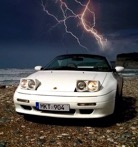
I had a chance to look at the car again today and have a couple of theories, which I'd appreciate some review of.
Yesterday, I cleaned up the earth to the ignition coil amplifier - mainly because it was screwed into a slightly dusty looking aluminium sheet. Tried cranking over, it was clear this hadn't changed anything, so I pulled the plugs out. They were wet with petrol, so I used a small blow lamp to burn that off and used a torch to look at the piston crowns, obviously they looked wet and a little sooty, particularly in pots 1 and 2. So I left it all open overnight to evaporate and this morning pulled fuse 5 (ECU) and cranked the engine over a few turns, before looking back at the piston crowns. Slight wetness in a couple of pots on the inlet side.
So, I'm considering leaking injectors again, which was my initial hunch.
Last night, I searched some more and found the correct setting for the idle bleed screw in the WIKI under 'tickover', which suggested that it should be 1.5 turns out from fully-in. Checked mine this morning and it was only just over half a turn, so, despite not putting the car back into service mode and adjusting the idle properly, I reset it as per other people's examples and drove it to a friend's garage in Croydon.
For fun I fitted a new set of plugs (NGK ones as per the WIKI) and drove the car the short way to Croydon, where I had the job of repairing a customer's Corsa D. (Note to self: these things are better got at first, rather than 4th hand, as there's 3 other people's diagnoses and fault repair attempts to re-diagnose and reject).
Anyway, back to my car. After fixing the Corsa (the Elan engine had cooled) I pulled the plugs out and inspected them. As before, no3 was quite white, the others were a medium browny colour, slightly black around the sides of the insulator. Again there was wetness on the piston tops, this time on pots 1 and 2 particularly.
I then spent well over an hour chuntering at my inability to fit a hose to the fuel rail input connection on the back of the inlet manifold. My reasoning was that I could measure the fuel pressure at idle and during a big blip of the throttle (or better, using a mityvac to actuate the fuel pressure regulator to confirm the pressure increases in non-idle conditions. I can't find anywhere a spec for what the fuel pressure should be though, so it was just going to be a 'I got x bar on my fuel rail, what should it be?' question on here tonight. Alas I chuntered on for a while and still couldn't fit the inline pipe and had to give up for the day. Good news though, I have borrowed the test kit and will have another go, probably after removing the rail.
Driving the car today was less pleasurable really, mainly because the engine 'felt wrong' and very occasionally misfired into the exhaust as it left idle. It's very wrong, I've done 135 miles on an indicated 3/4 tank of fuel, so I could have run a Veyron for the fuel consumption I have managed so far

. I won't drive it anywhere now until I have what looks to be a proper fix, as I don't want it to end up bore washed. Apart from anything else I am sick of the smell of unburned petrol!

On the way home I stopped off and connected up my Elanscan interface and logged the rest of my return journey, then left the engine to run until the cooling fans had cycled before switching off. I will attach the logged data in a mo, but the first thing I'd note is that the IAC is set solidly at 3 steps for the whole of the time it was idling and it couldn't (quite) get to the desired idle of 950, settling at 975 instead.
So I am also considering that there is an air leak somewhere. What I can't tell is whether it is in the inlet manifold (favouring cylinder 3 to make it run leaner than the others) or elsewhere, but I have been round replacing vacuum hoses and will continue doing so until I have got every last pesky one.
What's the community wisdom here, a combination of two faults, or something else?


Cheers,
Ian.


 by supplying an ALDL interface so I could use Elanscan to look at what the ECU thinks is happening.